Lost a Tooth? Here Are Your Replacement Options: Dental Implants, Bridges, and Dentures Explained
Losing a tooth can feel like a setback—for your smile, your confidence, and your quality of life. Whether it’s due to decay, injury, or gum disease, that gap can affect more than just your appearance. Over time, missing teeth can lead to bone loss, shifting of neighbouring teeth, and even changes to your facial structure.
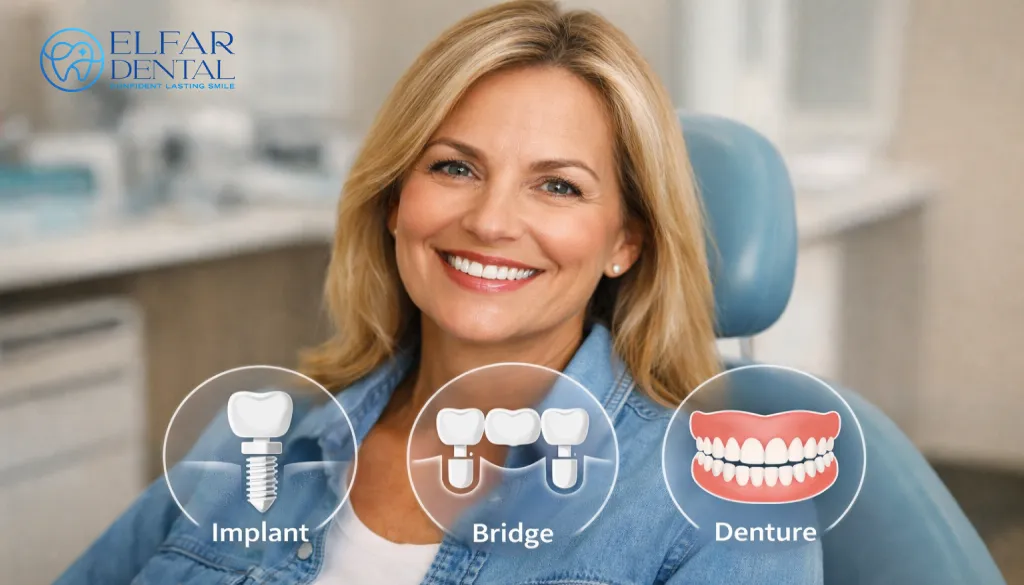
The good news? Modern dentistry offers excellent solutions to restore your smile. At Elfar Dental, we believe in empowering you with clear, honest information so you can make the best choice for your unique situation. This comprehensive guide will walk you through your three main tooth replacement options—dental implants, bridges, and dentures—explaining how they work, their benefits and limitations, and the factors to consider when choosing.
Why Replace a Missing Tooth?
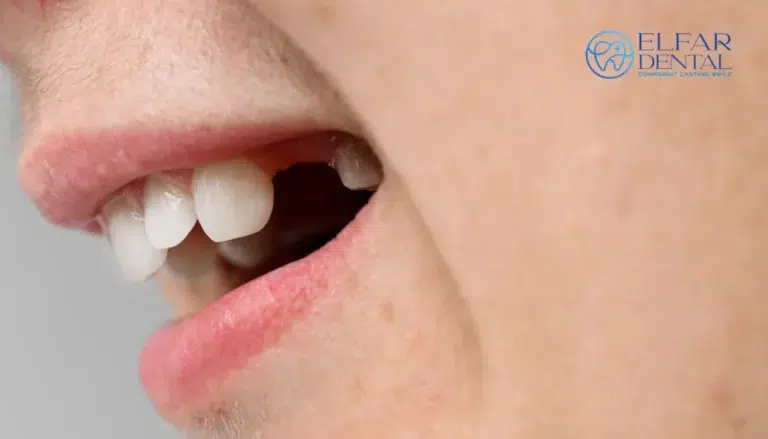
Before exploring your options, it’s important to understand why replacing a missing tooth matters. When a tooth is lost, your mouth begins to change almost immediately:
Jawbone shrinkage (resorption): The bone that once supported your tooth starts to deteriorate, beginning about six months after tooth loss.
Teeth shift: Adjacent teeth can tilt into the gap, causing bite problems and misalignment.
Increased risk of further tooth loss: The shifting and bite changes can weaken other teeth.
Facial changes: Bone loss can create a sunken appearance, making you look older.
Difficulty chewing and speaking: This can affect nutrition and social confidence.
Replacing a missing tooth isn’t just about aesthetics—it’s about preserving your long-term oral health.
Your Three Main Tooth Replacement Options
Let’s explore each option in detail, comparing how they work, their advantages, and their considerations.
Option 1: Dental Implants – A Leading Option
What Is a Dental Implant?
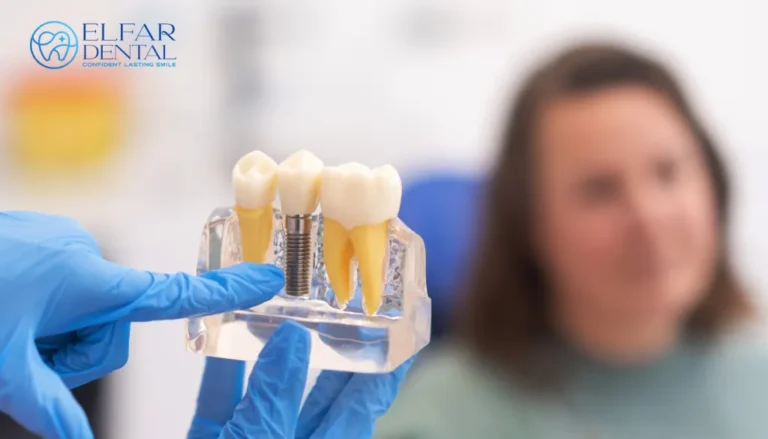
A dental implant is a small, biocompatible titanium post that is surgically placed into your jawbone to act as an artificial tooth root. After a healing period, a custom-made crown is attached to the implant, creating a restoration that looks, feels, and functions like a natural tooth.
A complete implant restoration has three components:
The implant: The titanium post that integrates with your jawbone
The abutment: A connector that attaches to the implant
The crown: The custom-made visible tooth (usually porcelain)
The Implant Procedure
| Stage | What Happens | Timeline |
|---|---|---|
| Consultation & Planning | Comprehensive exam, digital X-rays or CT scan to assess bone health | 1 visit |
| Implant Placement | Surgical placement of titanium post under local anaesthesia | 1-2 hours |
| Osseointegration | Bone grows around and attaches to the implant | 3-6 months |
| Abutment & Crown | Abutment attached, impressions taken, custom crown placed | 2-4 weeks |
The success rate for dental implants is excellent—over 96% at 10 years.
Advantages of Dental Implants
✅ Preserves jawbone: Implants stimulate the bone just like natural tooth roots, preventing bone loss and maintaining facial structure.
✅ Protects healthy teeth: No need to grind down adjacent healthy teeth—implants stand independently.
✅ Long-term durability: With proper care, implants can last a lifetime. Studies show survival rates of 98.9% at 3 years and 94% at 15 years.
✅ Natural look and feel: Implants mimic the function of natural teeth, providing excellent chewing efficiency and comfort.
✅ Easy maintenance: Clean just like natural teeth—brush, floss, and regular check-ups.
Considerations
❌ Higher upfront cost: Implants cost more initially than bridges or dentures.
❌ Longer treatment time: The process takes several months from start to finish due to the healing period required.
❌ Requires surgery: Implant placement is a surgical procedure, though performed under local anaesthesia.
❌ Requires adequate bone: Sufficient jawbone density is needed to support the implant. Bone grafting may be required if bone loss has occurred.
❌ Not suitable for everyone: Uncontrolled diabetes, certain autoimmune conditions, heavy smoking, or some medications may affect healing and implant success.
Option 2: Dental Bridges – The Fixed, Faster Solution
What Is a Dental Bridge?
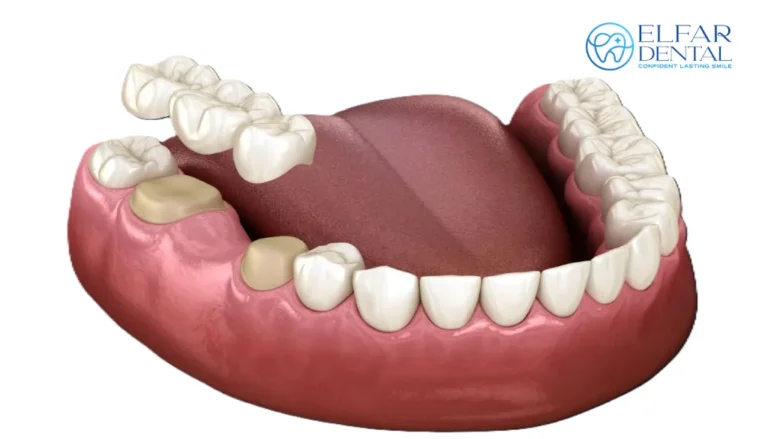
A dental bridge literally “bridges” the gap left by one or more missing teeth. It consists of artificial teeth (called pontics) anchored to the healthy teeth on either side of the gap. These adjacent teeth, called abutment teeth, are prepared (shaped) to support crowns that hold the bridge in place.
Types of Dental Bridges
| Type | Description | Best For |
|---|---|---|
| Traditional Bridge | Three-unit design: crown on one abutment tooth, pontic in middle, crown on other abutment | Missing one or more teeth with healthy teeth on both sides |
| Cantilever Bridge | Supported by only one adjacent tooth | Specific situations where only one side has a healthy abutment tooth |
| Maryland Bridge (Resin-Bonded) | Metal or porcelain wings bonded to the back of adjacent teeth | Front teeth, especially for patients wanting to minimise tooth reduction |
The Bridge Procedure
| Stage | What Happens | Timeline |
|---|---|---|
| First Appointment | Adjacent teeth are reshaped, impressions taken, temporary bridge placed | 1-2 hours |
| Laboratory Fabrication | Permanent bridge custom-made in dental lab | 2-3 weeks |
| Second Appointment | Temporary removed, permanent bridge fitted and cemented | 1 hour |
The entire process typically takes 2-3 weeks and requires no surgery.
Advantages of Dental Bridges
✅ Faster treatment: Complete in weeks, not months.
✅ Lower upfront cost: Generally less expensive than implants.
✅ No surgery required: Ideal for patients who prefer to avoid surgical procedures.
✅ Proven, reliable solution: Bridges have been used successfully for decades.
✅ Good for multiple adjacent missing teeth: Can replace several teeth in a row efficiently.
Considerations
❌ Requires grinding healthy teeth: Adjacent teeth must be permanently reshaped (about 1.5-2mm removed), which can increase their risk of decay and pulpitis.
❌ Doesn’t prevent bone loss: The jawbone beneath the bridge continues to shrink over time.
❌ Shorter lifespan: Bridges typically last 10-15 years and may need replacement.
❌ Harder to clean: Requires special flossing techniques (floss threaders or interdental brushes) to clean underneath.
❌ Increased stress on abutment teeth: Supporting teeth bear extra chewing force, which can lead to problems over time.
❌ Long-term cost: Multiple replacements over a lifetime can add up.
Option 3: Dentures – The Removable Solution
What Are Dentures?
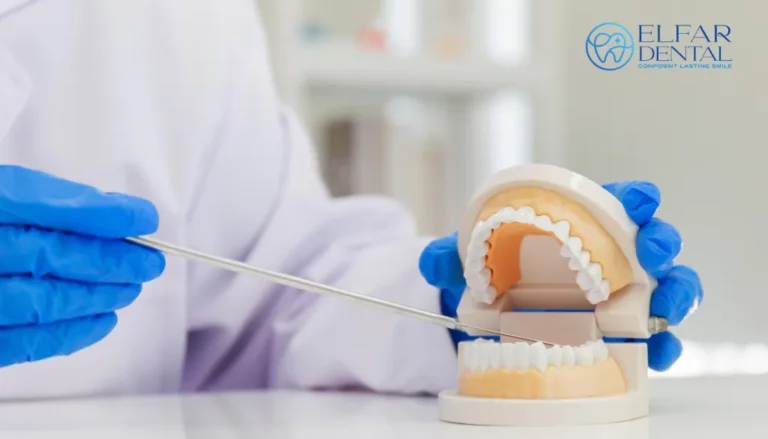
Dentures are removable prosthetic devices that replace missing teeth and surrounding tissue. They are custom-made to fit comfortably in your mouth and can be taken out for cleaning.
Types of Dentures
| Type | Description | Best For |
|---|---|---|
| Complete (Full) Dentures | Replace all teeth in an arch (upper or lower). Made after gums heal following extractions (conventional) or placed immediately after extraction (immediate) | Patients missing all teeth in an arch |
| Partial Dentures | Replace one or more missing teeth. Attach to remaining natural teeth with metal or flexible plastic clasps | Patients with some healthy remaining teeth |
| Flexible Dentures | Made of soft, bendable material for comfort and natural appearance | Patients seeking lightweight, flexible option |
| Implant-Supported Dentures (Overdentures) | Snap onto dental implants for enhanced stability and chewing ability | Patients who want more stability than traditional dentures |
Advantages of Dentures
✅ Most affordable option: Lowest upfront cost of all tooth replacement options.
✅ Non-invasive: No surgery required for conventional dentures.
✅ Quick to make: Can be fabricated relatively quickly.
✅ Removable: Easy to clean and maintain.
✅ Flexible dentures: Lightweight and comfortable.
✅ Implant-supported options: Provide improved stability for those who qualify.
Considerations
❌ May feel uncomfortable initially: Takes time to adjust; may cause irritation or increased saliva at first.
❌ Can affect speech and eating: May require practice to speak clearly and chew effectively.
❌ Requires adhesive: Conventional dentures need adhesive to stay in place.
❌ Can become loose over time: As jawbone changes shape, dentures may need relining or replacement.
❌ Doesn’t prevent bone loss: Jawbone continues to shrink, which can affect denture fit long-term.
❌ Shorter lifespan: Typically last 7-10 years before needing replacement.
❌ Regular adjustments needed: Should be checked every 1-2 years for proper fit.
❌ Implant-supported option: Still removable but requires surgery and higher cost.
Comparison at a Glance
| Factor | Dental Implant | Dental Bridge | Dentures |
|---|---|---|---|
| Initial Cost | Highest | Moderate | Lowest |
| Long-Term Value | Excellent—can last lifetime | Moderate—needs replacement | May require multiple replacements |
| Treatment Time | Several months | 2-3 weeks | Weeks to months |
| Surgery Required | Yes | No | No (except implant-supported) |
| Impact on Adjacent Teeth | None | Grinds down healthy teeth | Can put stress on remaining teeth |
| Bone Preservation | Yes—stimulates bone | No—bone continues to shrink | No—bone continues to shrink |
| Lifespan | 20+ years to lifetime | 10-15 years | 7-10 years |
| Maintenance | Normal brushing/flossing | Special cleaning tools | Removable; soaking/cleaning |
| Stability | Like natural tooth | Fixed but can loosen | Can shift; may need adhesive |
| Appearance | Most natural-looking | Natural-looking | Good, but can look artificial |
Which Option Is Right for You?
The answer depends on your individual situation. Here are questions to consider:
Choose a Dental Implant If:
✅ You want the most durable, long-lasting solution.
✅ You want to preserve neighbouring healthy teeth.
✅ You want to prevent bone loss in your jaw.
✅ You value natural-looking and natural-feeling results.
✅ You have adequate jawbone health (or are willing to have bone grafting).
✅ You’re willing to invest more upfront for long-term benefits.
Choose a Dental Bridge If:
✅ You need a tooth replacement quickly (within weeks).
✅ You have healthy teeth adjacent to the gap that can support a bridge.
✅ You’re not comfortable with surgical procedures.
✅ Budget is your primary concern right now.
✅ You’re missing multiple adjacent teet.
Choose Dentures If:
✅ You’re missing many or all of your teeth.
✅ You need the most affordable option.
✅ You prefer a non-invasive approach.
✅ You’re willing to remove and clean them daily.
✅ You’re a candidate for implant-supported dentures and want enhanced stability.
Medical Conditions That May Affect Your Choice
Several health factors can influence which tooth replacement option works best for you:
Uncontrolled diabetes: May slow healing and affect implant integration
Autoimmune diseases or cancer treatments: Can complicate implant procedures
Medications: Steroids or immunosuppressants might make implants less viable
Bruxism (teeth grinding): Puts extra pressure on implants or bridges
Smoking, excessive alcohol, or recreational drugs: Can negatively impact healing and increase implant failure risk
Your dentist at Elfar Dental will evaluate your specific situation and help determine which option aligns with your health needs and goals.
The Elfar Dental Approach
At Elfar Dental, we don’t believe in a one-size-fits-all answer. Your smile is unique, and your treatment plan should be too.
Your Tooth Replacement Journey With Us:
1. Comprehensive Consultation
We begin with a thorough examination, including digital X-rays and assessment of your oral health, bone structure, and personal goals.
2. Personalised Discussion
We explain all your options—implants, bridges, dentures—with clear information about benefits, risks, timelines, and costs. No pressure, just honest guidance.
3. Collaborative Decision-Making
The choice is always yours. We’re here to answer your questions and support your decision.
4. Expert Treatment
Whether you choose implants, a bridge, or dentures, our experienced team provides gentle, high-quality care using the latest technology.
5. Ongoing Support
We’re with you for the long term, ensuring your restoration stays healthy and functional for years to come.
Frequently Asked Questions
Q: Which lasts longer, a dental implant or a bridge?
A: Dental implants can last significantly longer—often a lifetime with proper care. Bridges typically last 10-15 years before needing replacement.
Q: Are dental implants worth the extra cost?
A: While implants cost more upfront, their exceptional durability often makes them more economical over a lifetime. You’ll likely need fewer replacements and repairs compared to bridges.
Q: Can I replace a bridge with an implant later?
A: Yes, you can. This requires adequate jawbone to support the implant. If you’ve had a bridge for many years, bone grafting may be needed due to bone loss beneath the bridge.
Q: Does dental insurance cover these procedures?
A: Coverage varies widely by plan. Our team will help you understand your benefits and work with your provider to maximise your coverage.
Q: Is the implant procedure painful?
A: The procedure is performed under local anaesthesia, so you should not feel sharp pain during surgery. Most patients report less discomfort than expected, managed well with medication.
Q: How do I care for my restoration?
A:
Implants: Brush and floss normally, just like natural teeth.
Bridges: Use floss threaders or interdental brushes to clean underneath.
Dentures: Remove nightly, clean with soft brush and denture cleaner, soak in water.
Q: What if I have multiple missing teeth?
A: All options can address multiple missing teeth. Implant-supported bridges, multiple implants, or implant-supported dentures may be recommended depending on your situation.
Conclusion: Your Smile, Your Choice
Losing a tooth doesn’t mean losing your smile. Modern dentistry offers options to restore function and appearance. Whether you choose a dental implant, a bridge, or dentures, the right choice is the one that aligns with your health, goals, and lifestyle.
At Elfar Dental, we’re here to guide you through this decision with professional advice and compassionate care—no pressure, just partnership.
About Our Dental Practice

Ready to Explore Your Tooth Replacement Options?
The first step toward restoring your smile is a conversation. Let’s discuss your situation, answer your questions, and help you choose the path that’s right for you.
Schedule your consultation at Elfar Dental today. Your smile journey starts here.
Your Belconnen dentist. Discover more about our dental care services. Book a visit.
Ready to book your appointment?
📞 Call Our Family-Friendly Team at (02) 6251 9991
💻 Book online easily at Get Appointment
📍 Visit our modern clinic at 21 Benjamin Way, Suite 5F, Belconnen ACT 2617
Elfar Dental – Your partner for family dental care in Belconnen, Canberra, ACT.
Important Note:
This information is for educational purposes and should not replace professional dental advice. Every patient’s situation is unique, and treatment decisions should be made in partnership with qualified dental professionals. Always seek the advice of your dentist with any questions about your oral health. If you have severe dental phobia, speak with your dentist about appropriate management options.